
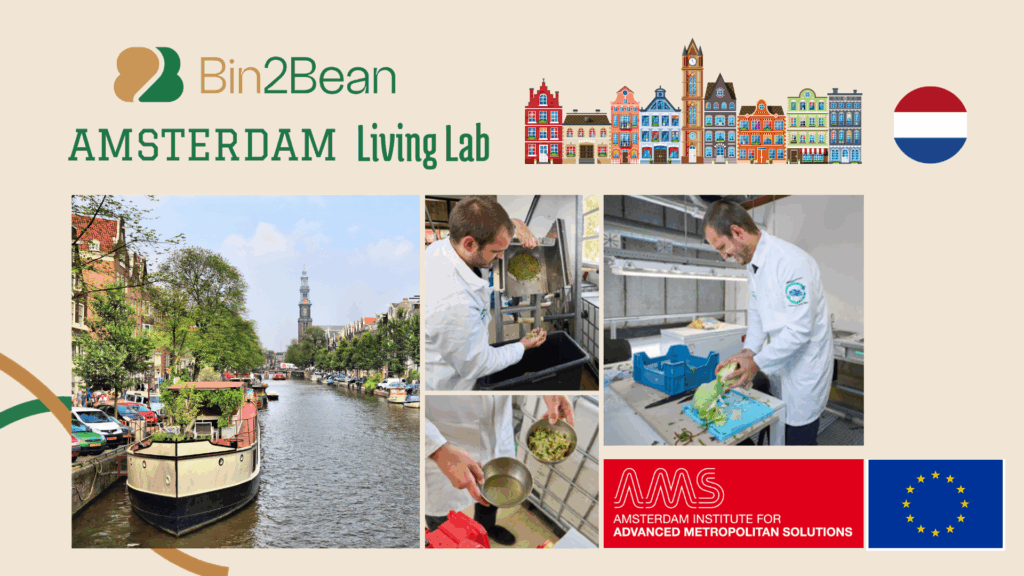
The Amsterdam Living Lab represents a crucial research and experimentation initiative, aimed at addressing the complex challenges of food waste management in a high-density urban area.
Context and Urban Challenges
Since the 1990s, Amsterdam has conducted several pilot experiments on organic waste collection, some of which have now become regular collection routes, but to date only around 10 to 20% of organic waste is collected separately. Around 98% of food waste is still included in the residual waste and thus incinerated to produce electricity and heat.
The city’s urban environment, comprising 85% apartment buildings and multi-story residences, makes it difficult to implement traditional household collection schemes. Additional challenges include the absence of local recycling facilities (as national plants are already operating at full capacity) and the high contamination of food waste, which generates distrust among farmers regarding the use of urban compost.
The vision of the LL is to create a new model for the collection and reuse of food waste, specifically designed for multi-story buildings, by directly involving citizens in designing and testing the system, and by establishing a fair pricing mechanism.
Living Lab Activities and Outputs
Amsterdam LL includes various experimental activities, such as collaboration with 25 communities (approximately 100 households each) in composting initiatives. Recently, a new member, BiCy, was welcomed, a French company focused on developing innovative waste collection services.
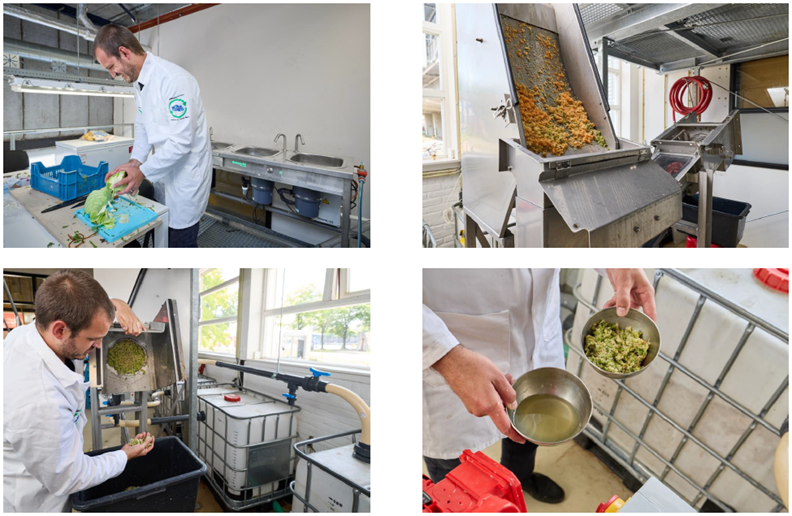
One of the key technologies under testing is the Kitchen Sink Grinder (KSG), a small kitchen device that grinds food scraps, reducing their volume and facilitating collection. During experiments, a capture rate of about 30 to 50% of the dry matter originating from the food waste, is collected in the dewatered ground food waste. With the optimalization of the installation, expectations are that this capture rate will increase to 65%.
A crucial finding is that the dynamics between participation rates, separation, and collection must be carefully studied, as participation rates vary significantly across different separation and collection methods.
The main outputs of the LL include the definition of scenarios and corresponding baselines, assessing solutions such as KSG-based separation in high-rise buildings and wet/dry separation. The tested solutions cover separation, collection, and treatment (e.g., two-stage wet anaerobic digestion, nutrient recovery, and post-composting), with potential applications ranging from community gardens to Dutch and Belgian agriculture.
Analysis and Evaluation Tools: context specific data
In terms of B2B product recommendations, the Amsterdam LL suggests that context-generic assessments are not relevant for municipal decision-making, emphasizing instead the need for context-specific data and well-articulated scenarios.
Thus, another ongoing development is the use of a context-specific dataset generator, a tool designed to provide context-specific input data for Life Cycle Assessment, socio-economic analyses, potential business model development or other assessments.
The generator tracks losses and availability of carbon (C), nitrogen (N), phosphorus (P), and potassium (K) throughout the entire production chain based on the processing technologies involved in each scenario. Additionally, transport kilometres, electricity, consumption and productions are included. Based on this, a dataset is produced per scenario containing the necessary input data for the assessments.
With the tracking of nutrients, it was also determined to that there are different nutrient retainment levels between the different scenarios.